Why Does a Horse Buck: Personality or Pain?
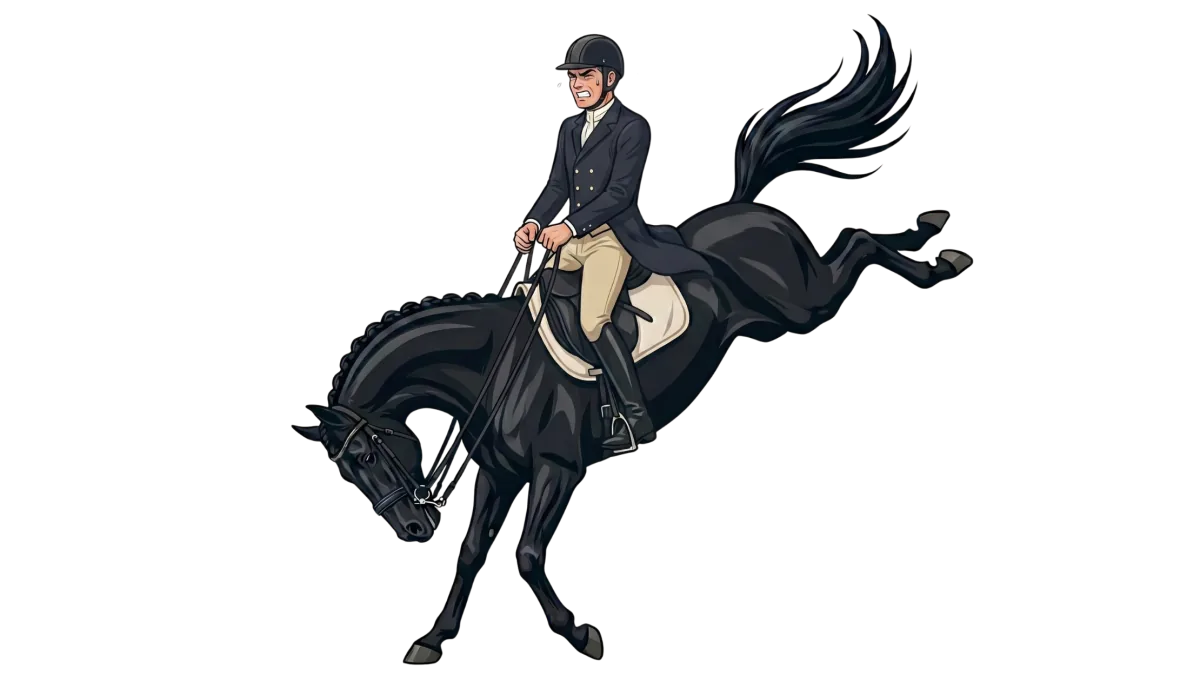
When a horse starts bucking, kicking out behind, or trying to unseat the rider, the old-school answer is usually simple: “he is just naughty”, “he is testing boundaries”, “you need to be stricter”. But that should not be the starting point. Let us pause and ask ourselves: what is the horse’s body trying to tell us?
- Any sudden movement or protest is not “bad behavior” caused by being spoiled. Most often, it is a signal of discomfort, fear, tension, or imbalance.
- One single “explosion” does not give the full picture. It is important to look at everything together: how the horse moves, what the back is like, the state of the hooves, the tack, and the nervous system.
- The professional and humane first step is not to try to “push through” with force, but to collect observations, understand the real cause, and act before the problem grows.
Why “personality” is the easiest, but often wrong, answer
A horse cannot speak with words. He cannot complain about a headache, a tight muscle, or an uncomfortable saddle. So his body speaks through movement: through tension, freezing, refusing to go forward, sudden reactions, and changes in normal behavior.
A new approach to working with horses begins exactly here — not with pressure, but with the ability to listen. This does not mean every problem has the same cause. But it does mean the horse should not automatically be labeled as “naughty”.
If the animal protests, it means that a certain load, touch, or body state may be causing pain or anxiety.
What to look at before making conclusions
Do not look for one simple answer. This needs careful work with facts.
Analyze when the reaction appears. Does it repeat during tacking up, transitions, bending, after hoof trimming, or when the back is touched lightly?
Pay attention to what happened before the “explosion”. Always notice the small warning signs that come before the breakdown: a tense neck, a shorter or stiffer step, reluctance to move forward, increased sensitivity during grooming, pinned ears, a worried tail, or general nervousness.
Remember what has changed recently: new tack, a different farrier, a change in workload, a new turnout routine, a different stable place, or the condition of the hoof horn.
What not to do
❌ Do not increase pressure. If the horse is already showing resistance and you start demanding more harshly, you simply silence the signal. From the outside, it may look like “obedience”, but the problem remains inside and can come out later with even more force.
❌ Do not label the horse. Conclusions like “he is just lazy” or “he needs a firm hand” do not help — they only move you further away from the real cause.
❌ Do not diagnose from one reaction. The job of an attentive owner is to see patterns, avoid chaotic decisions, and involve trusted specialists when needed: a veterinarian, trainer, farrier, or manual therapist.
A horse cooperates with us only when he feels safe and nothing is troubling him. Let us be more attentive to our four-legged partners! 🐴