Horse Pins Ears When Tacking Up: What It May Mean
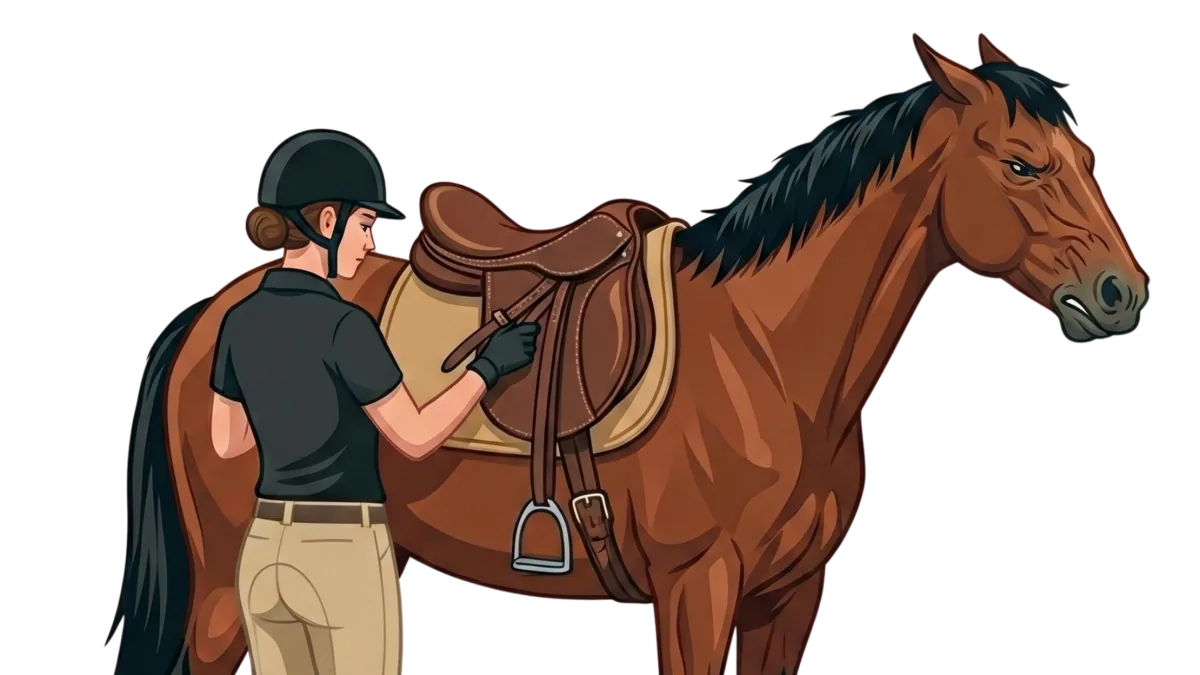
When a horse squints or pins the ears during tacking up, the response is often: “he is just naughty”, “he does not like being saddled”, or “he is testing boundaries”. But pinned ears, an attempt to bite, or a tense back in that moment are not a whim. This is the moment when the horse is already saying clearly that something is not okay. The owner’s task is not to overpower it, but to understand exactly where it hurts or presses.
- The issue is not always the saddle itself.
- Everything matters: how the saddle sits, what girth is used, the state of the back muscles, the hooves, and the horse’s overall stress level.
- This kind of reaction always has a specific physical reason, even if it is not visible at first glance.
Why tacking up is the best marker
The saddle touches the body every day. If there is chronic tension or tightness in the back area, the horse may show it before you even get on.
Ears, snapping teeth, or attempts to step away are not reasons to scold the animal for “bad manners”. They are reasons to stop and look more carefully. The main principle is simple: this reaction always has a specific physical cause, even if it is not visible at first glance.
Sometimes the owner changes the pad or girth and the reaction stays. Tack is not separated from the body: hooves, back, shoulder movement, training, pain, and the nervous system can all connect.
That is why “buy another saddle” is not always a complete answer.
If the horse reacts exactly during tacking up, the cause is not automatically only the saddle. But the contact area, tack position, and back state should become part of the check. The point is not to explain everything away as attitude, but to see the system.
A professional frame for owners
If the reaction repeats, do not ignore it and do not tighten through resistance. Collect observations: when the horse reacts, with which saddle, in which body area, before or after work.
Do not rush into random equipment changes or saddle adjustments by eye. Gather facts, look at the horse as a whole, and then decide who needs to be involved.
From there, the next step is a structured check, not random equipment changes. Knowledge and consistent checks work better than ignoring signals.